
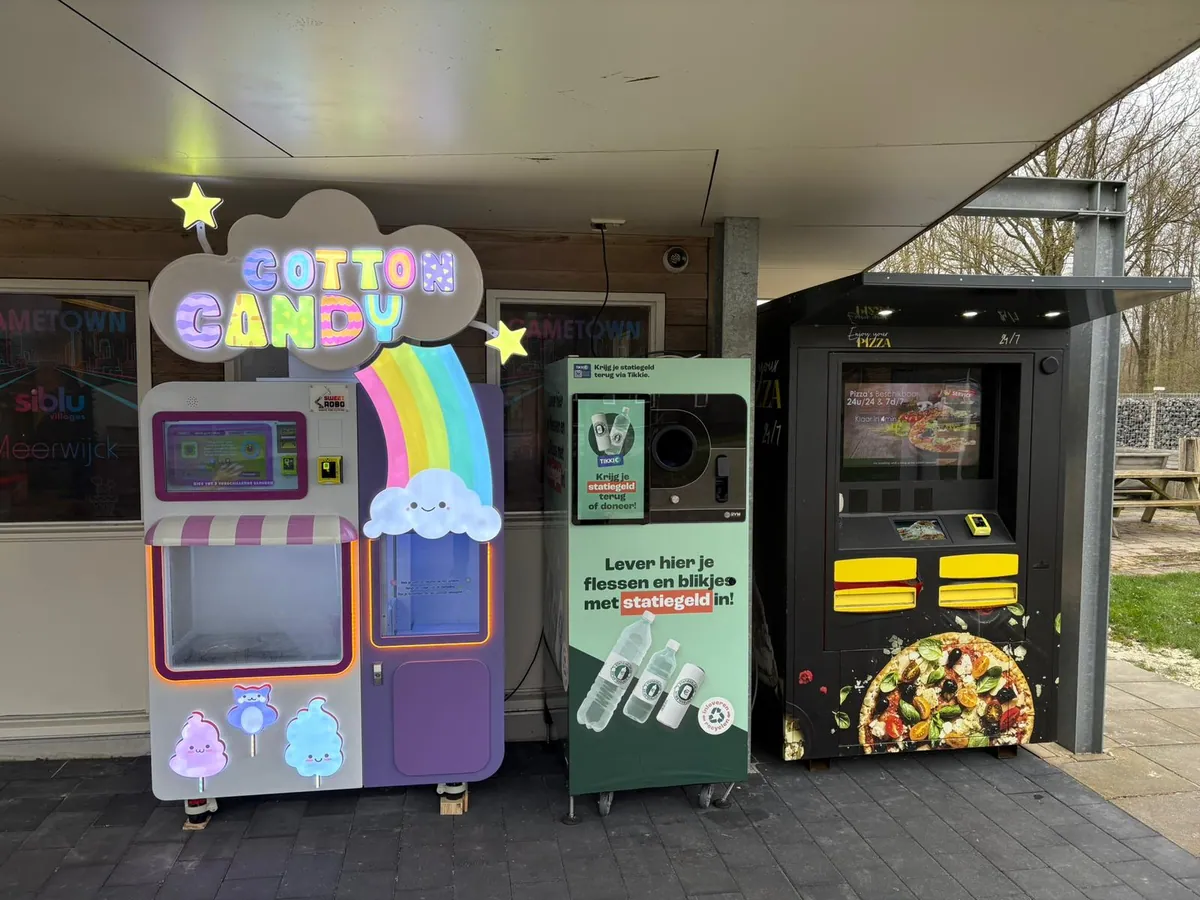
Quick answer: Vending machine cost in Europe splits into three tiers: a used snack or drink machine from a few hundred euros, a new professional snack or drink machine in the low thousands, and a robotic machine that makes fresh product on demand in the five figures. The purchase price is only part of it — location rent, consumables and payment fees decide whether the machine pays back.
Key takeaways
- The headline price of a vending machine tells you very little; the running costs and the ticket size decide the return.
- Snack and drink machines are cheap to buy and cheap to earn from: typical tickets of €1–3 with thin margins against retail nearby.
- Robotic treat machines cost more up front and sell at €4–8 per item, from ingredients that cost cents.
- Budget for four running costs: location rent, consumables, payment processing and occasional service.
- Sweet Robo operators in Europe report roughly €1,500–€3,000 per month per well-placed location.
“How much does a vending machine cost” is the most common question we get from new European operators, and the honest answer is that the purchase price is the least interesting number in the calculation. A €900 machine that earns €150 a month is a worse business than a machine that costs far more and earns ten times that. Here is the full cost picture in euros, and the maths that actually matters.
What a vending machine costs to buy
Prices vary by country, condition and supplier, but the European market sorts into three clear tiers.
| Machine type | Typical purchase cost | Typical ticket | What it sells |
|---|---|---|---|
| Used snack / drink machine | Low hundreds to ~€1,500 | €1–3 | Packaged snacks, cans, bottles |
| New professional snack / drink machine | Low thousands | €1–3 | Packaged snacks, cans, bottles |
| Robotic treat machine | Five figures | €4–8 | Fresh cotton candy, ice cream, popcorn, balloons |
Sweet Robo’s European machines sit in the third tier, quoted in euros with shipping and import included, and financing or leasing is commonly available. Exact pricing depends on the model and how many units you start with — the EU team quotes per configuration rather than publishing a single number, because a single countertop unit and a full standalone kiosk are different purchases.
The costs nobody puts in the quote
Four running costs decide your actual margin. Budget all four before you buy anything.
Location rent. The standard European arrangement is a fixed monthly fee to the venue owner. Strong venues — malls, family entertainment centres, holiday parks — cost more and are worth more. Some venues take a revenue share instead.
Consumables. This is where robotic treat machines win outright. A serving of cotton candy is spun from a few cents of flavoured sugar and sells for €4–8. Packaged snacks are bought at wholesale and sold against the shop 50 metres away, which caps both your price and your margin.
Payment processing. Cashless is now the majority of transactions at impulse price points across Europe. Card fees are small per transaction but real, and they scale with revenue rather than with machine count.
Service and parts. Rare on a well-built machine, expensive when parts ship from another continent. This is the cost that most often turns a cheap machine into an expensive one — a machine down for three weeks in high season loses more than the part ever cost.
Why the ticket size matters more than the price tag
Run the same 40 sales a day through two machines and the difference is stark. At a €2 ticket that is €80 a day; at a €6 ticket it is €240. Same footfall, same rent, same visit schedule — three times the revenue, from a product whose ingredient cost is measured in cents.
That is the whole argument for the robotic tier, and it is why the payback period on a more expensive machine is frequently shorter than on a cheap one. Sweet Robo operators across Europe report roughly €1,500–€3,000 per month per well-placed location on a few hours of upkeep per week. Earnings depend on foot traffic, season and venue — the vending machine business page sets out the payback maths in detail.
The second earner does not appear on any invoice: attention. A robot spinning a pink cloud behind glass stops foot traffic in a way a snack machine never will, customers film it, and the queue markets the venue. That is why many European venues actively invite these machines rather than charging premium rent for them.
How to compare two quotes properly
Ask every supplier the same five questions, and compare the answers rather than the prices:
- Is the quote in euros, with shipping, import and duties included? A dollar price that becomes a customs bill is not a quote.
- Is it CE-marked with a declaration of conformity, and native 230V/50Hz? Converted machines add cost and failure points.
- Where do spare parts ship from, and how fast? Sweet Robo supports EU operators from the Netherlands, with representatives in France and Germany.
- What is included — installation, training, telemetry app, warranty? Sweet Robo includes setup, training and support access rather than selling them separately.
- Does the supplier help you find a location? Placement help is worth more than a discount, because the venue decides the revenue.
Which machine gives the best return in Europe?
For most new European operators, the best return comes from a machine that sells an experience at a treat price point in a high-footfall family venue — a cotton candy vending machine, an ice cream vending machine, or a popcorn machine. The full machine range shows what each one makes and where it fits.
Frequently asked questions
How much does a vending machine cost in Europe?
Vending machine cost in Europe falls into three tiers: used snack and drink machines from a few hundred euros, new professional snack and drink machines in the low thousands, and robotic machines that make fresh product on demand in the five figures. Robotic machines cost more up front but sell at €4–8 per item against ingredient costs of a few cents, which is why their payback period is often shorter.
What are the running costs of a vending machine?
The four running costs are location rent paid to the venue, consumables, card payment processing fees, and occasional service or parts. Location rent and consumables dominate. Robotic treat machines have unusually low consumable costs — sugar, cups and packaging — while packaged-snack machines carry wholesale stock costs and price competition from nearby shops.
How long does it take a vending machine to pay for itself?
It depends far more on the location and the ticket size than on the purchase price. A machine selling €6 treats in a busy family entertainment centre can pay back several times faster than a cheap snack machine in a quiet corridor. Sweet Robo operators report roughly €1,500–€3,000 per month per well-placed location, which is the figure to run your own payback maths against.
Is it cheaper to buy a used vending machine?
Cheaper to buy, not necessarily cheaper to own. Used machines are typically packaged-snack units with low tickets, no telemetry and no warranty, and parts for older models can be difficult to source in Europe. The saving on the purchase is easily lost to downtime and low margins.
Do I need to pay rent for a vending machine location?
Usually yes. The standard European model is a fixed monthly fee to the venue owner, sometimes replaced by a revenue share. Strong locations cost more and earn more. Because robotic machines draw crowds, some venues treat them as an attraction and negotiate accordingly — see what a machine does for your location.
Related reading: Smart vending machines in Europe · How to start a vending machine business in Europe · Cotton candy vending machine buyer’s guide
Written by the Sweet Robo Europe team — 200+ machines shipped to Europe in the last 12 months, across 15+ countries, supported from the Netherlands. Talk to the EU team for a euro quote.