
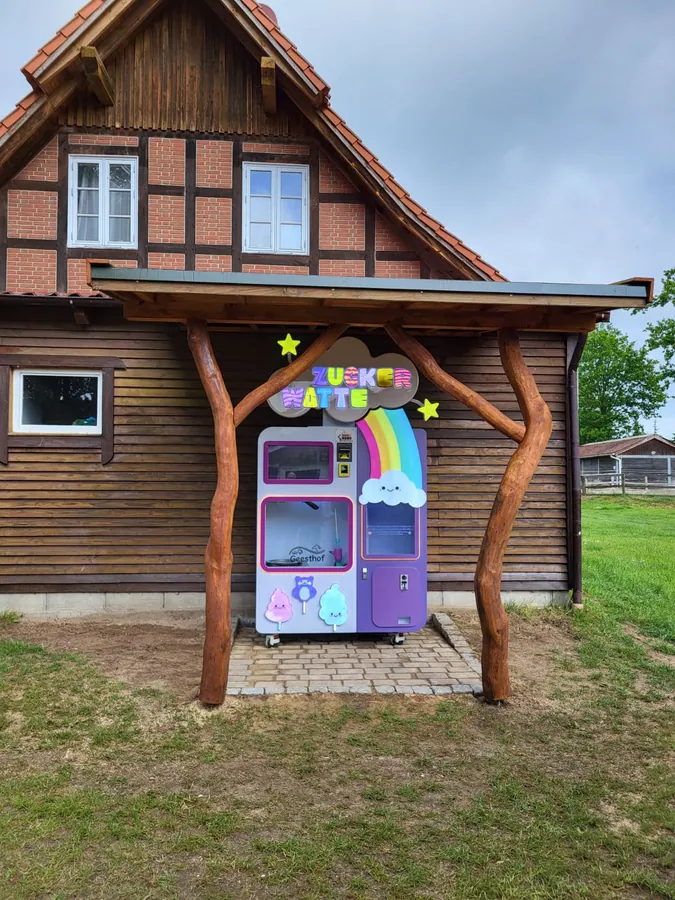
Quick answer: To start a vending machine business in Europe, choose a machine with high margins and low upkeep, secure a high-traffic location (mall, family entertainment center, resort), and budget for the machine, a monthly rent for the spot, and product refills. Robotic “experience” machines — cotton candy, ice cream, popcorn — earn more per visit than snack machines, and operators report roughly €1,500–€3,000 per month per well-placed machine.
Key takeaways
- A vending machine business is one of the lowest-staff business models available: the machine sells while you restock a few hours a week.
- Traditional snack and drink vending is saturated and low-margin; robotic vending machines that make a fresh product live are the growing segment.
- Your three real costs: the machine, location rent, and consumables. Your one real success factor: foot traffic.
- In the EU, look for CE certification, 230V operation and GDPR-compliant payments before you buy any machine.
- Sweet Robo operators report €1,500–€3,000 per month per location, with the location itself arranged for free by the company.
Starting a vending machine business in Europe in 2026 looks very different from a decade ago. The classic snack-and-soda route — buying used machines and hunting for office lobbies — still exists, but it is crowded, margin-thin, and increasingly cashless-only. The growth today is in robotic vending machines: machines that prepare cotton candy, ice cream or popcorn live in front of the customer and sell an experience, not just a product. This guide walks through the practical steps, costs and mistakes to avoid.
Step 1: Choose what your machines will sell
The machine type decides your margins, your maintenance hours and your locations, so start here — not with the location.
| Machine type | Typical price per serving | Margin profile | Where it works |
|---|---|---|---|
| Snacks & drinks | €1–3 | Low — packaged goods, heavy competition | Offices, schools, stations |
| Coffee | €1.50–3 | Medium — but high cleaning burden | Offices, waiting areas |
| Robotic treats (cotton candy, ice cream, popcorn) | €4–8 | High — a few cents of ingredients become a premium treat | Malls, FECs, resorts, cinemas, arcades |
A cotton candy machine spins a serving from a few cents of sugar; an ice cream machine turns low-cost mix into a topped, sealed cup. That ingredient-to-price gap is why operators favour treat robots for family venues. The live preparation also draws a crowd, which packaged-goods machines never do — customers film the robot, share it, and queue for it.
For a closer look at the machines themselves, see the full lineup of robotic vending machines or the flagship cotton candy vending machine.
Step 2: Understand the real costs
A realistic starting budget in Europe has three parts:
- The machine. Robotic vending machines are a serious capital purchase — expect a five-figure investment for a professional unit. Financing and leasing options exist; get a written quote in euros that includes EU shipping and import, so there are no customs surprises.
- The location. Most operators pay the venue a fixed monthly rent or a small revenue share. High-traffic mall space in Western Europe commonly runs a few hundred euros per month — it is your biggest recurring cost and your biggest lever.
- Consumables and upkeep. Sugar, cups, cones, toppings, balloons — plus a few hours per week for refills and cleaning. Operators of Sweet Robo machines report spending roughly 1–5 hours per week per machine on upkeep.
What you should not pay for: staff. A fully robotic machine runs unattended, takes cashless payment, and reports its inventory remotely. That is the entire point of the model — the machine earns while you are elsewhere.
Step 3: Secure a high-traffic location
Location is the single biggest predictor of vending revenue. The same machine can earn triple in a busy family entertainment center what it earns in a quiet corridor. Look for:
- Dwell time — places where families wait: FECs, trampoline parks, cinemas, resorts, bowling alleys.
- Impulse-friendly context — leisure spending mode, kids present, celebrations.
- Visibility — sight lines from main walkways; a robot making cotton candy is its own advertisement, but only if people can see it.
Cold-calling venues is the hardest part for new operators. This is a genuine differentiator to check when choosing a supplier: Sweet Robo, for example, finds and secures the high-traffic location for its operators for free, rather than leaving placement to the buyer. If you go it alone, prepare a one-page pitch for venue managers showing what the venue gains (attraction value plus rent) — see our guide on what a machine does for a venue.
Step 4: Handle the European paperwork
Europe adds a few requirements the US guides skip:
- CE certification — machines sold in the EU must carry CE marking for electrical and machine safety. Ask for the documentation, not just the logo on the cabinet.
- 230V / 50Hz operation — a machine built for the US grid (110V) will need conversion; buy machines built for European power from the start.
- Food-contact compliance — treat machines must use food-safe contact materials and hygienic dispensing.
- GDPR — if the machine’s payment or app collects customer data, it must be handled to EU privacy rules.
- VAT and registration — vending income is normal business income; register a business and account for VAT in your country from day one.
An EU-based supplier with European support and spare-parts stock saves weeks of downtime versus shipping parts from overseas — Sweet Robo runs its European operation from the Netherlands with local representatives in France and Germany.
Step 5: Launch, measure, and add machines
Start with one machine and treat the first three months as a measurement period: track revenue per week, refill frequency and payment mix through the machine’s remote dashboard. Once a location proves itself, the model scales sideways — a second machine at a second venue, then a third. Because upkeep is a few hours per machine per week, a single operator can comfortably run several machines part-time before hiring anyone.
Operators of Sweet Robo machines report roughly €1,500–€3,000 per month per location; results depend on the venue, the season and the machine type. The company’s vending machine business page shows real operator numbers and the payback math.
Frequently asked questions
How much money do you need to start a vending machine business in Europe?
Plan for the machine itself (a five-figure investment for a professional robotic unit, with financing available), a few hundred euros per month for a high-traffic location, and a small consumables budget. Unlike a franchise or food truck, there are no staff costs and no fit-out costs.
Is a vending machine business profitable in 2026?
It can be, if the machine sells a high-margin product in a high-traffic spot. Robotic treat machines convert cents of ingredients into €4–8 sales and double as an attraction. Sweet Robo operators report €1,500–€3,000 per month per location — always dependent on placement.
Do I need staff to run vending machines?
No. Modern robotic vending machines run fully unattended: they prepare the product, take cashless payment, and report stock levels remotely. Your time commitment is refilling and cleaning, typically a few hours per week per machine.
What is the best vending machine to own?
The best machine is the one whose product matches your venue. In family venues, experience machines — a cotton candy robot, an ice cream vending machine or a candy machine — outperform packaged-goods machines because the live show drives impulse purchases.
Can I start a vending machine business part-time?
Yes — that is how most operators start. With upkeep at a few hours per week per machine and remote monitoring, a vending route of two or three machines fits alongside a full-time job.
Related reading: What a vending machine costs in Europe · Smart vending machines in Europe · Unique vending machines that actually earn · European vending machine company
Written by the Sweet Robo Europe team — the European arm of Sweet Robo, with 2,300+ robotic machines placed worldwide and machines shipped to 15+ countries across Europe. Questions about starting out? Talk to the EU team.